
When I wrote my last blog post, at the end of July, I’d admitted temporary defeat with my sewing machine and was waiting more or less patiently for a one-to-one workshop booked with Hobbycraft. The workshop was basically make or break: if I remained frustrated and clueless at the end of that, I’d put the machine on ebay and write it off as an expensive experiment.
I arrived at Hobbycraft convinced my machine hated me and that I simply didn’t have the skills necessary to make it work properly.
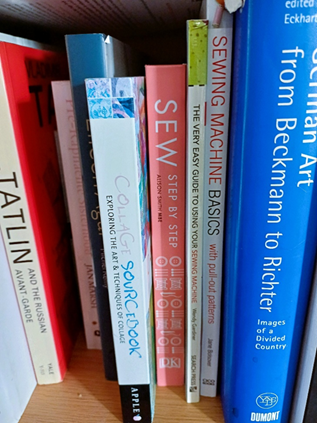
It was slightly odd having my lesson in the shop itself, but my teacher made me feel very welcome and not like a complete numpty for not being able to get to grips with a machine that is particularly suitable for beginners. She told me how she’d been sewing for many decades, having learned literally at her mother’s knee. My mum could darn a sock, sew on a button, all the very basic stuff, but she never owned a sewing machine, so my only experience came from school sewing lessons (which did not go well). So of course, for me, even a very basic machine seemed like an object from outer space.

My first textile art project, using a combination of machine and hand sewing. The composition was then glued to a cradled wooden panel
My teacher went through the basics (which weren’t at all basic to me), and it’s the little things that make all the difference, and these aren’t always spelled out either in the manual or in YouTube videos, which is why a one-to-one was so useful: the fact, for instance, that the presser foot needs to be in the up position when threading, and also the reason why the handle must always be turned towards you rather than away – things I would have paid more attention to if I’d realised how crucial they are! I now know that if something looks wrong, the first thing to do (after taking a deep breath and inhaling strong coffee) is to re-thread the machine.
But the most important things of all that my teacher told me were not to be intimidated by the machine; and that I should spend time getting to know it, to allow myself to make lots of mistakes as part of the learning process rather than expecting everything to go smoothly from the get-go. Sometimes the thing we need more than anything is to give ourselves permission to make mistakes: to play, to get stuff wrong, to take our time.
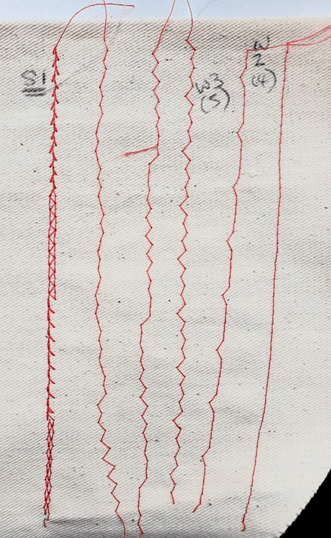
Experimenting with stitches
I spend some time nearly every day (sometimes only 5 or 10 minutes on working days) trying out different stitches, different functions and techniques. A few days ago I had a problem in that the stitches were ‘looping’ (nesting) but only when reverse stitching. Before my Hobbycraft lesson, I would have given up in frustration (and most likely thrown something across the room to boot). Not now. I unthreaded top and bottom threads, re-threaded the machine, and everything worked perfectly. I’ve done a complete about face, from loathing the machine to finding it hard to stay away from it and being thrilled with every stitch as I gently guide the fabric under my hands.
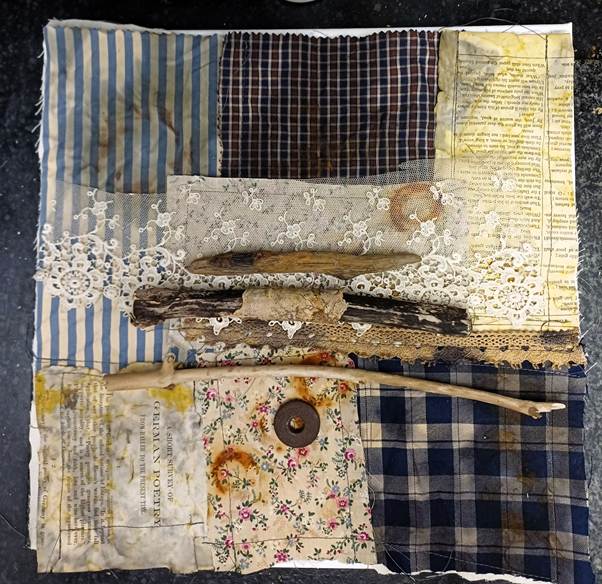
Work in progress (approx. 30cm square) featuring rust-dyed fabrics and papers
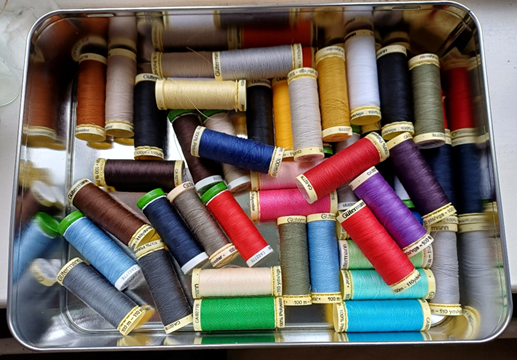
I’m now enjoying gathering accessories. I’ve bought more Gütermann threads in a variety of colours (fairly neutral shades for the most part), a good quality pair of sewing scissors, a box of glass-headed pins, and lots of bobbins so that I can pre-wind bobbins with the colours I’m likely to use the most. I’ve also ordered a free motion foot for my machine, and a pincushion. Needles, again, so many different types for different materials and thicknesses. After much research, I bought a selection of universal ones, also some Microtex (for very delicate fabrics) and ballpoint (for light knits, which I hope will work with some of the stretch laces I have). It’s a whole new world, and a steep learning curve, but I want to make sure I want to use the right tools for the job. Where machine sewing is concerned, it really is cheaper in the long run to invest in good quality products rather than trying to wing it with cheaper ones.
Videos I’ve found particularly useful:
https://sewingmastery.com/singer-heavy-duty-4423/ – a large number of tutorials for the Singer HD 4423
https://www.youtube.com/watch?v=6ZLDJd248v4&list=PL_q5YqwI-HyXJUGAga88qjJCZoEjlfpCX&index=7&t=2363s – how to thread and wind a bobbin (Singer 4452 but applicable to any Singer Heavy Duty model). The tutorial includes tips for different fabrics, and some basic sewing techniques
https://www.youtube.com/watch?v=j034grIju7A&list=PL_q5YqwI-HyXJUGAga88qjJCZoEjlfpCX&index=6 – Beginner’s Sewing Machine Workshop
https://www.youtube.com/watch?v=XmVUU5kKTLY – Free motion sewing
 Helen Kitson
Leave a comment