I’ve always felt as if September should be the first month of the year. A hangover from childhood, no doubt, the school year always beginning in September. A new uniform, empty notebooks, newly-sharpened pencils. For many years (in particular the first two year of high school) also a time of dread. But most of the time it signalled possibilities, a fresh start, a clean sheet; an optimism that was rarely matched by reality. We carry echoes and traces of the past into our present and I’ve never managed to outrun my past (does anyone?). Perhaps, in some ways, that’s a good thing; I try to maintain a positive attitude and find the good stuff even during the hardest times.
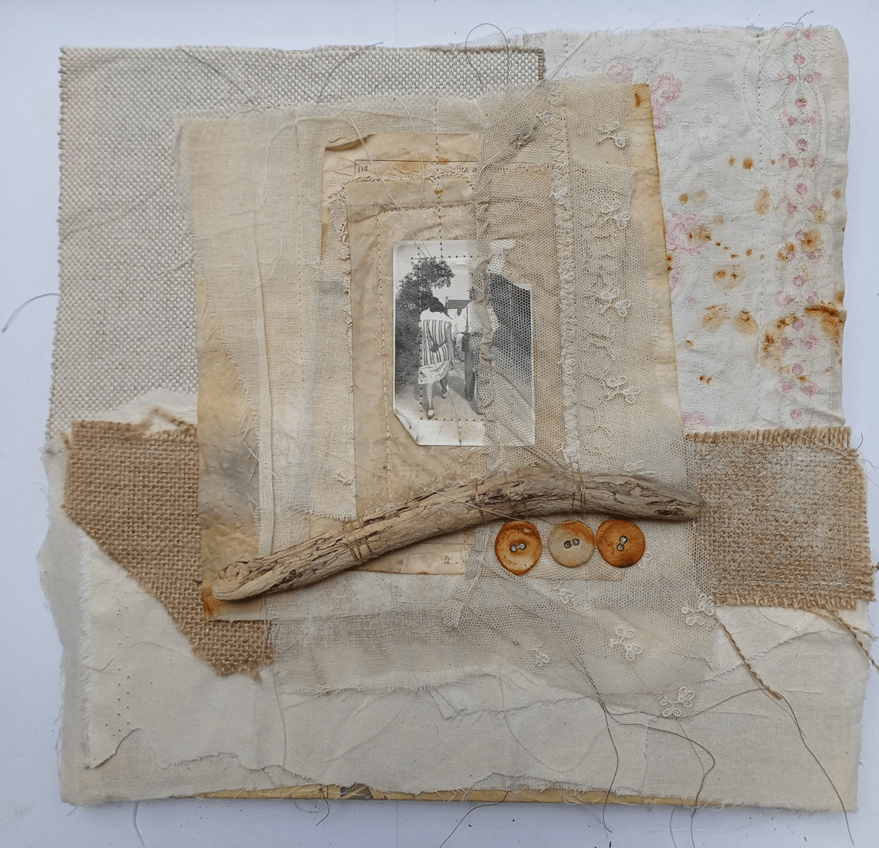
“Don’t Look Back” © Helen Kitson, 2025. Mixed media collage on 30cm square cradled canvas. An evocative found photo provides the focal point. My fondness for neutral colours has definitely carried over from paper into my textile work. The hessian and calico were given to me by my sister-in-law Louise. The driftwood was sourced from a beach in the north of Scotland
Lately I’ve been spending a great deal of time rust-dyeing fabric remnants. The results are unpredictable, which is something I love: there’s nothing quite as satisfying as the happy accident! When I’m not doing that, I’m getting to know my sewing machine better and learning all I can about textile art (hand-stitching as well as machine sewing). In many ways it’s not much different from creating collages with paper and glue except, of course, I use stitch instead of glue. The basic principles are the same in the way that I compose each piece, starting with a rough idea and improvising/altering as I go along.
The fabrics I use in my work have, for the most part, been given to me by generous relatives who understand (or at least indulge!) my insatiable desire for materials to use in my artwork. Locally I have also discovered, through a friend and former work colleague, the most amazing shop right on my (work) doorstep. Remade Worcester “is a charity committed to rescuing quality craft materials from landfill and making them available to the public at affordable prices” and that’s exactly what they do. I visit every Wednesday and Thursday lunchtime, and it’s just as well I take a 30-minute lunchbreak from work, because if I was in there any longer there would be no stock left by closing time. They stock the most amazing selection of fabrics, both large rolls and remnants, all beautifully and neatly presented, and they’re also a fabulous source of embroidery threads (which I use for hand-sewn elements in my work) and all manner of sewing-related ephemera. It’s an absolute goldmine for sewists and crafters and I’m extremely lucky to have such an amazing resource in my home town.
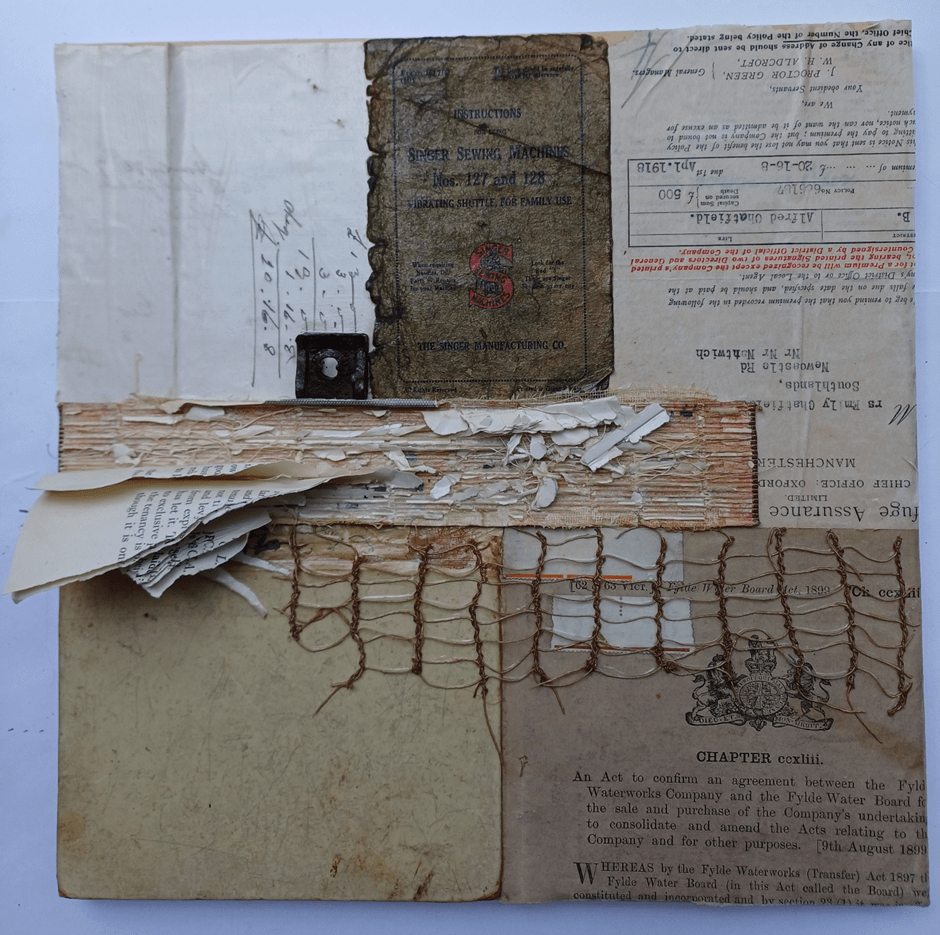
© Helen Kitson, 2025. A work on 30cm square cradled canvas, composed before I’d properly got to grips with my sewing machine, but the cover from a vintage Singer sewing machine instruction booklet and the string (from a bag of organic onions) represent a big step towards incorporating stitch into my work
I’ve always been an all or nothing person, but I think my new-found obsession with textile art is in any case a useful distraction from the US tariffs and the implication of those for artists who sell their work to the US. Admittedly, there are other things going on in the world that are far more significant, but I think it’s important also that we hold on to what is good in our lives, and sweating the small stuff isn’t always a wholly bad thing. I’ve suspended sales to US customers for the time being, until the situation (currently a tangle of conflicting messages) is clearer. For me this is a big deal, as the majority of the buyers of my work are in the US. But at the same time it’s not the end of the world for me since I have a ‘proper job’, and annoying as the situation is I’m quite glad to have this time in which to explore and create without worrying too much about the outcome or about potential sales.
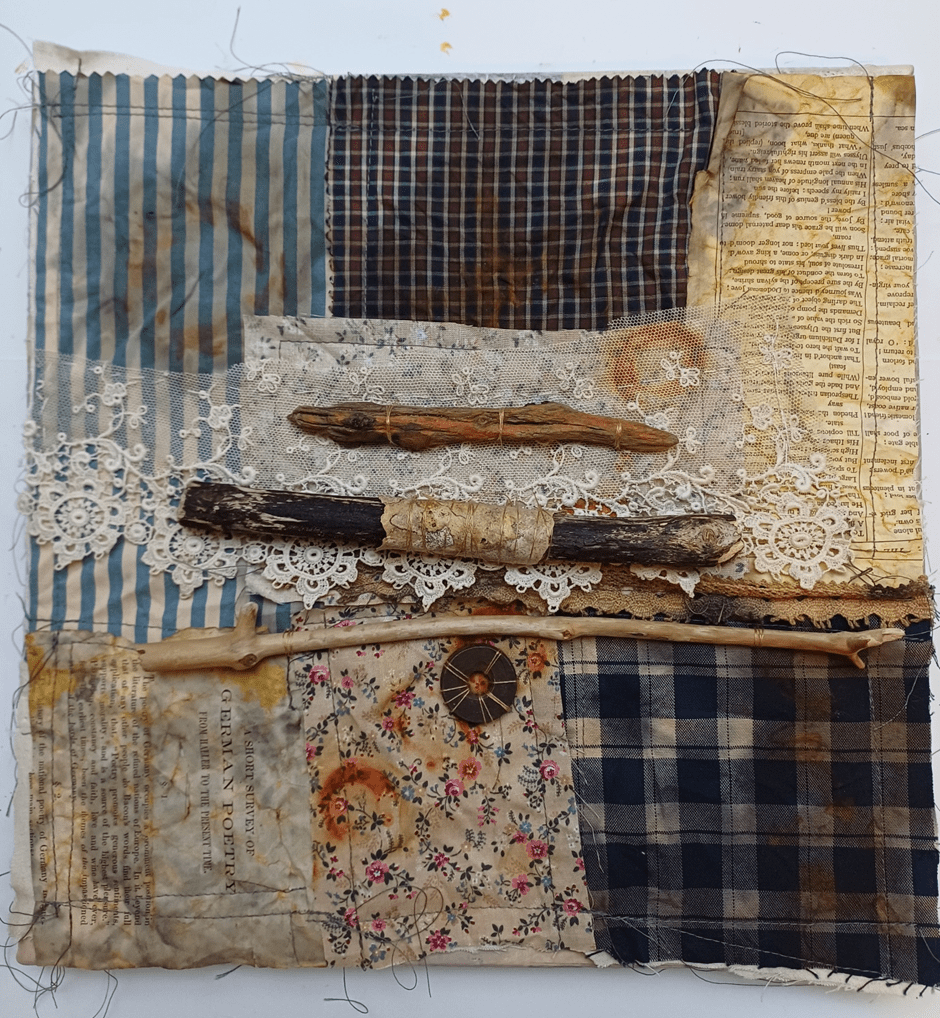
© Helen Kitson, 2025. Another work on cradled canvas, 30.5 cm square. This is one of several pieces that I composed referencing the patchwork and embroidery I enjoyed doing when I was young. I’ve never owned a sewing machine until I bought my Singer 4423 earlier this year. I made the patchwork quilt by hand and also covered a pair of jeans with embroidery, again all by hand. In those days I tried my hardest to make my work neat. These days, I much prefer the messy and the imperfect, the freedom of creating intuitively instead of trying (and inevitably failing) to be ‘good’
The rules surrounding the tariffs are incredibly problematic (and in some cases seemingly contradictory). And I can understand countries wanting to decrease the amount of drop-shipped goods being imported (although I’m willing to bet that the biggest players will find ways to circumvent the tariffs, as is usually and depressingly the case), but it also hits small businesses and creatives particularly hard. A discussion for another day, perhaps, and of course I’m grateful to anyone who buys my work, wherever they’re from, and grateful above all that I have the time to do what I love best, which is attaching things to other things!
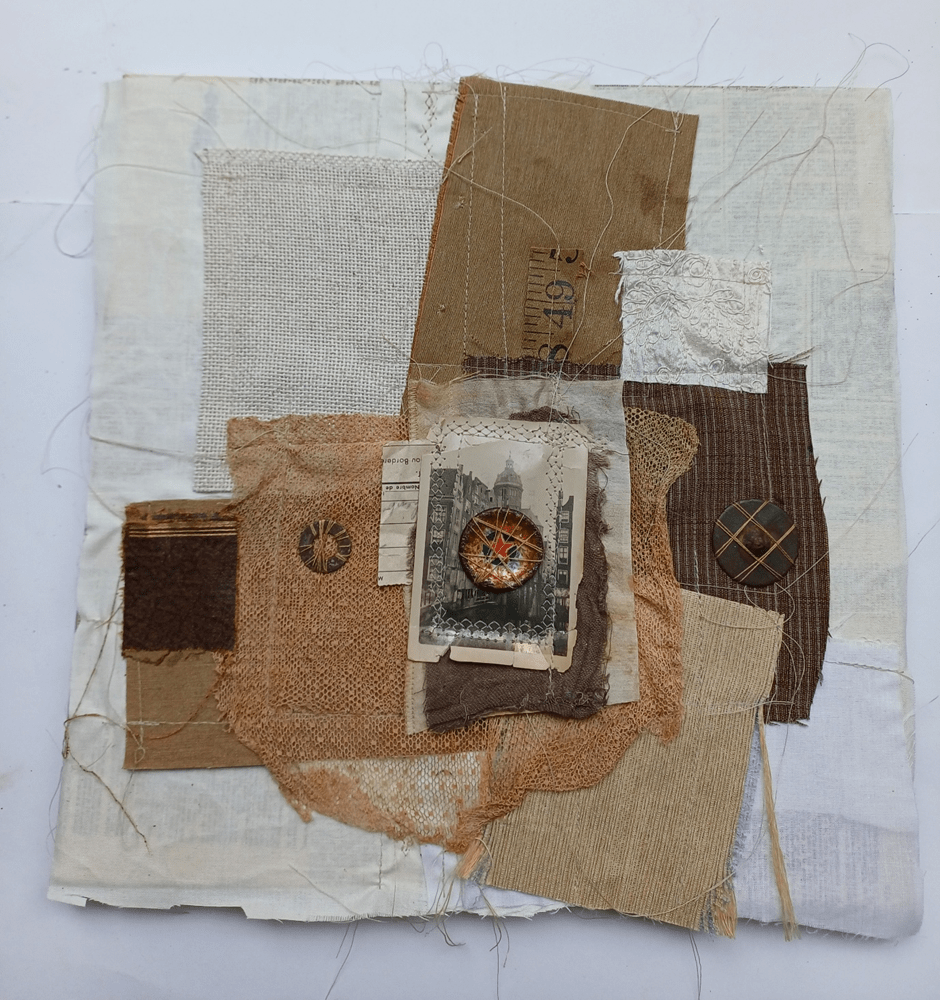
For this piece on 30cm square cradled canvas I took my inspiration from the collages made by Picasso and Braque, such as the one below, which still look fresh and exciting over a century on
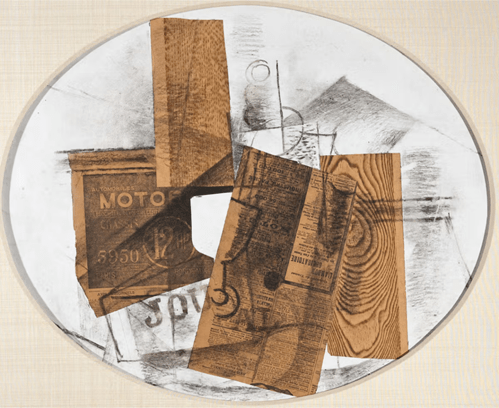
Georges Braque. Bottle, Glass, and Newspaper, 1914. Charcoal and cut-and-pasted newspaper and printed wallpaper on gessoed paperboard (commercial board from mirror backing), Oval 19 7⁄8 × 24 1⁄4 in. (50.5 × 61.6 cm). The Metropolitan Museum of Art, New York, Leonard A. Lauder Cubist Collection, Gift of Leonard A. Lauder, 2016 (2016.237.14) © Metropolitan Museum of Art © 2022 Artists Rights Society (ARS), New York / ADAGP, Paris
 Helen Kitson
Leave a comment