I’m currently reading ‘Art making, Collections & Obsessions’ by Lynne Perrella, which is an absolute treat for any mixed media artist who can’t resist collecting All The Things. As Perrella says, ‘Once a collector, always a collector’. As a child I collected stamps and Wade Whimsies. As an adult, I collected books and records. There are, of course, any number of reasons why we collect our particular ‘objects of desire’ and although, as I get older, I worry about the amount of stuff I’ve accumulated and try to get rid of things I know I’ll never use/look at/read again, collecting is in my bones.
I spend most of my lunchtimes wandering around the charity shops looking for what I can only describe as bits and bobs: items that defy categorisation. Almost anything can be an object of desire: a battered golf ball, a set of wooden blocks, a German beer mat, a pack of circular playing cards. The only thing they have in common is that something about the way they look or feel, or the associations they conjure up, compels me to take them home with me.
Mixed media artists are the magpies of the art world, but it’s rarely the new, shiny things we go for. Rust is more appealing. The patina of age, of use; the wear and tear of time leaving its mark.
*
I wish I could remember when I first discovered the work of Joseph Cornell, but sadly I can’t. Until I saw reproductions of his work, I had a vague idea of him as a reclusive self-taught artist obsessively constructing boxes in the basement of his house. This crude idea I had of him was shattered when I came to appreciate the artistry and lyricism of Cornell’s work; its delicacy, poignancy and poetry.

Joseph Cornell, Untitled (Medici Princess), a box completed in 1948
Although heavily indebted to Cornell’s work, my own altered boxes are far more modest. For a start, I don’t make any of my own boxes, instead using wooden boxes found in charity shops or (in the case of the small cigar boxes) sourced on eBay.
I like to add what I think are my own personal touches, but in true magpie fashion pretty much everything I make takes its inspiration from a collage artist, past or present.
The first box I made (below) began life as a birthday present that originally contained Turkish Delight. My biggest challenge was to find a way to collage around corners and to make the box a cohesive whole. I chose a found photo to use on the lid of the box, which depicts a woman with two young children (presumably her own). I’ve no idea who they are or if any of them are still alive, and I don’t know how the album of photos this was taken from ended up on Ebay. The photo has added poignancy for me because my husband and I have embarked on the mammoth task of digitising all our photos to protect and preserve them for future generations, who may or may not care about them anyway. We’ll keep the physical photos, but who knows what afterlives they might have?
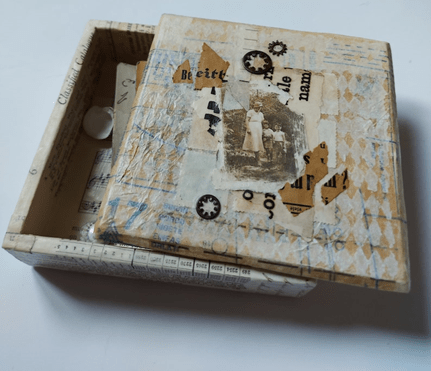
Having chosen the photo, that set the tone for the whole piece. Other lives, other places, a kind of second-hand nostalgia for these discarded odds and ends that I want to cling on to and hold fast. This box contains playing cards that have been collaged and also some random seashells, which speak of the timelessness of the natural world.
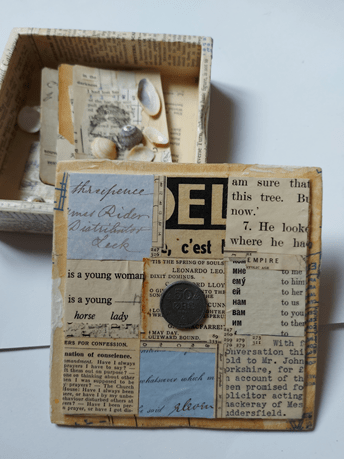
The lovely thing about the boxes is that they can be beautiful things in their own right but they also hold surprises when you lift the lid. Kynaston McShine describes Joseph Cornell’s boxes as ‘reliquaries for the fragment, the souvenir, the talisman’. Even more romantically, Dawn Ades suggest Cornell’s boxes can be seen as ‘sailor’s sea chests, with contents rich and strange or salvaged from a wreck’. (Both quotes from ‘Joseph Cornell’ ed. McShine, Museum of Modern Art, New York.)
I very much like both of these ideas and, like Cornell, I am constantly looking for new treasures to salvage. Whether it’s a pigeon’s feather found on the path on my walk to Tesco, an old coin or a rusty key, it evokes particular emotions and has a story to tell.
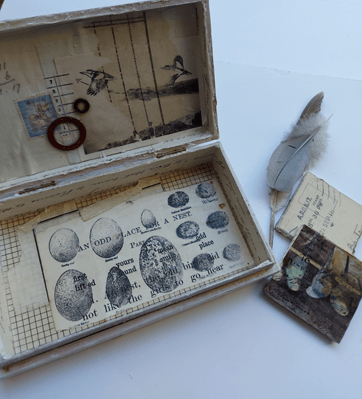
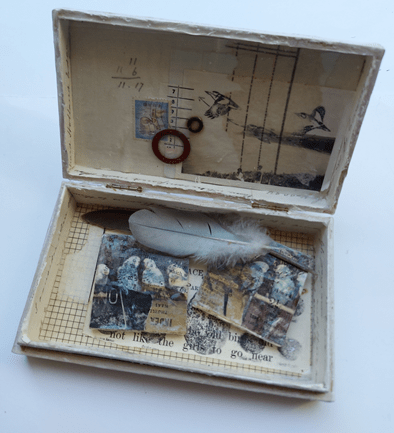
Some of my boxes have specific themes, such as my bird box (below).
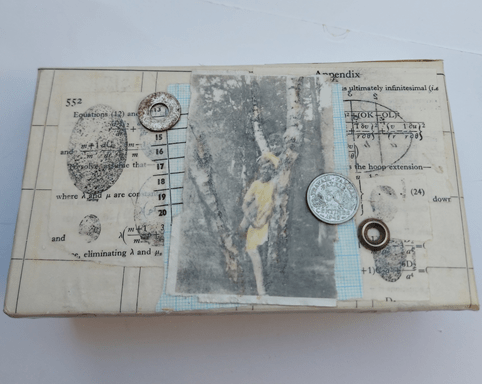
One of my earliest childhood memories is of finding a small blue broken eggshell, which I treasured until the small son of one of my parents’ friends smashed it. Whether it was an accident or deliberate I can’t remember, and I’m sure my parents must have told me not to make such a fuss over something that was broken anyway, but its importance to me is clear in the way that I’ve never forgotten (or quite forgiven) this small incident.
Again I used a found photo as my starting point, gently colourising the photo after treating it with bleach. This box contains two found feathers and two wooden squares which have been collaged and, on one side of each square, I’ve added packing tape transfers of birds, taken from a vintage French magazine.
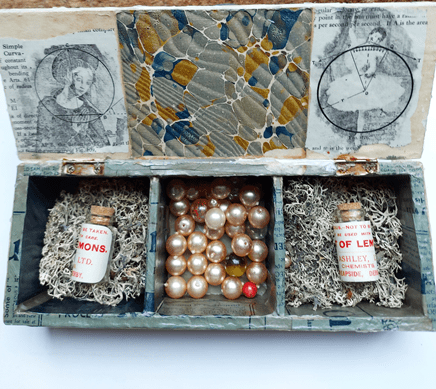
The final piece I want to share with you (below) began life as a trinket box with some horrible twee writing on it (‘Life’s a beach’ was one of the messages). I used an old record sleeve to collage the compartments, then added some new ‘trinkets’: beads from a broken necklace, lichen collected on holiday in Inverness, and two little bottles that contain fragments of mussel shells.
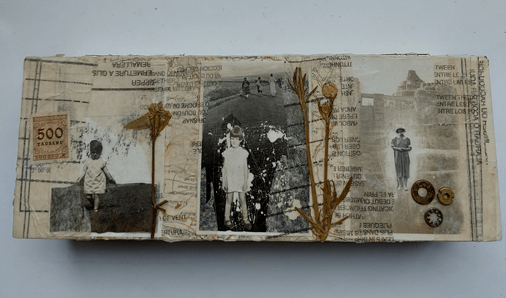
I used three found photos on the lid of this box, all of which I altered, and each photo is composed from two photos. What stories the box tells is really up to each individual viewer, but I am powerfully reminded of these words by Diane Waldman when considering Joseph Cornell’s boxes: ‘The box is a treasure chest, one containing many of life’s secrets and mysteries … all of his objects were to be placed in the warmth and security of a box where they could be cherished and protected’ (from ‘Joseph Cornell: Master of Dreams).


 Helen Kitson
Leave a reply to Helen Kitson Cancel reply