
My random collection of what I can only describe as stuff is an important source of inspiration as well as the raw material for my work. It’s possible I will only ever use a fraction of it, but its presence is necessary. This urge to collect, to gather, to surround ourselves with objects that please us, is I suspect common to most collage artists, and reflected in the gorgeous and inspiring book ‘Art Making, Collections & Obsessions’ by Lynne Perrella (although it will probably immediately make you want to go out and track down all the different types of things collected by the artists featured in the book; in the course of which you will likely fall down some weird and wonderful rabbit holes!).
What you decide to collect and use in your artwork is of course a very personal thing, but the methods of collecting are similar whatever type of ephemera you use.
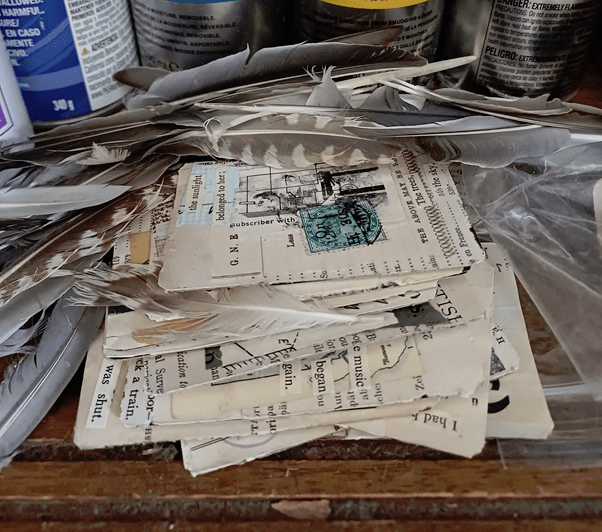
The first thing I’ll say is that, even though I use many found items in my work, they weren’t all necessarily ‘found’ in the sense of ‘picked up for free’. I use eBay a great deal as a source of ephemera, but I’ve learned to tailor my searches, not just to get bargains, but to get the best kind of ephemera that works for me. As a general rule, I would say avoid curated themed packs of papers. They can be useful, and I will occasionally use them to pick up a particular type of paper I want, but I find them a bit sterile, and not a particularly satisfying way of sourcing papers.
Instead, I tend to look for unsorted joblots, and these can be real treasure troves of gloriously random papers. If there’s a particular type of paper you want (receipts, old envelopes, old train tickets, etc) I can pretty much guarantee there will be people selling it on eBay. You might want to jump straight in if the lot you want is a ‘buy it now’ and something special, but it’s usually a good idea to put several possibilities in your watch list in case you come across something even more stunning. As always with auctions, keep an eye on the total price (including P&P), set a maximum amount you’re willing to pay, and stick to it. Sometimes I’ll keep several lots in my watch list and bid at the last minute on the one that has no current bidders – I know from experience how easy it is to get carried away in a bidding war!

If vintage photos are your thing, my top tip here is to look out for old albums containing photos rather than buying photographs singly, especially if the seller has included a good number of photos to give you an idea of the subjects of the photos. If you want to use your own precious family photos, I always recommend scanning them and printing them out and then using image transfer techniques to give them a proper vintage feel.

Similarly, if you use postage stamps in your work, seek out old, tatty, incomplete stamp albums, as
the stamps will generally be older and more interesting than those you’ll get in a ‘worldwide mixture’. Fewer stamps, but much better quality (from an artist’s point of view rather than a philatelist’s!).
Charity shops can also be a brilliant source of paper and vintage ephemera. It’s very hit or miss so you need to go regularly, and in doing so you’ll get a feel for which shops are best for which kind of items. I buy all my old books from charity shops – their weight makes the cost of postage uneconomical to buy these from eBay. And even if you don’t end up using what you buy from charity shops, your money has at least gone to a good cause, and you can always donate them back again!
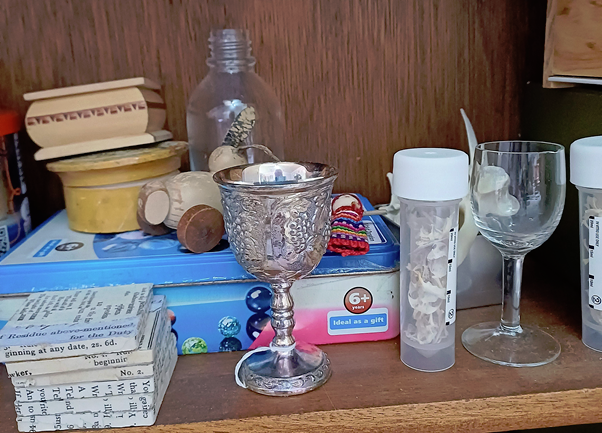
Finally, there are the genuine ‘found objects’, which are perhaps the most satisfying of all. I spend my summer holidays scouring beaches for shells, mermaid’s purses, sea glass, pebbles, driftwood and animal bones (note, if you want to clean animal bones, please don’t use bleach; hydrogen peroxide is the stuff to use – Google is your friend!).
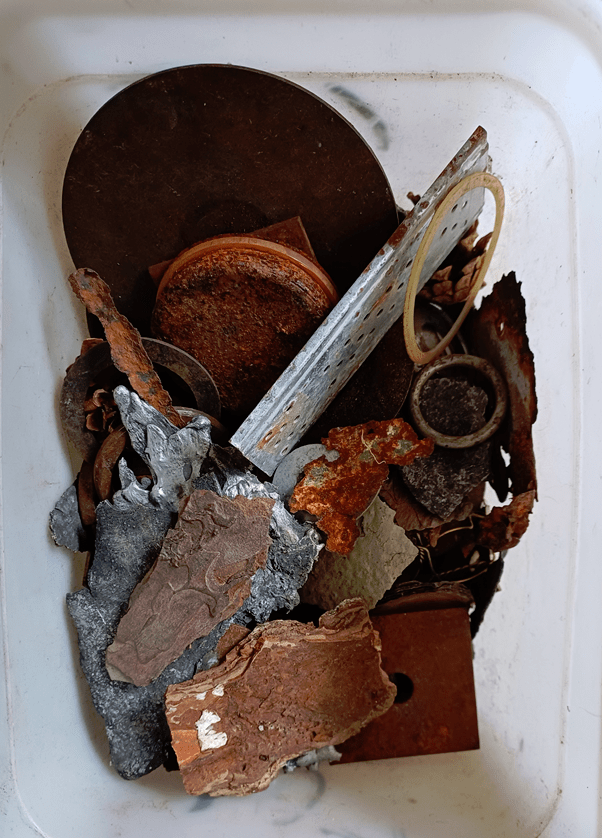
Harbours are also great for bits of rusty metal. I’m also always looking out for feathers and flowers. I press flowers from my own garden, and weeds I’ve found growing wild. You don’t need a fancy flower press, just a few very heavy books and patience.
My tops tips are always to think outside the box, be aware of what’s lying right at your feet, and channel your inner mudlark!


 Helen Kitson
Leave a reply to Helen Kitson Cancel reply